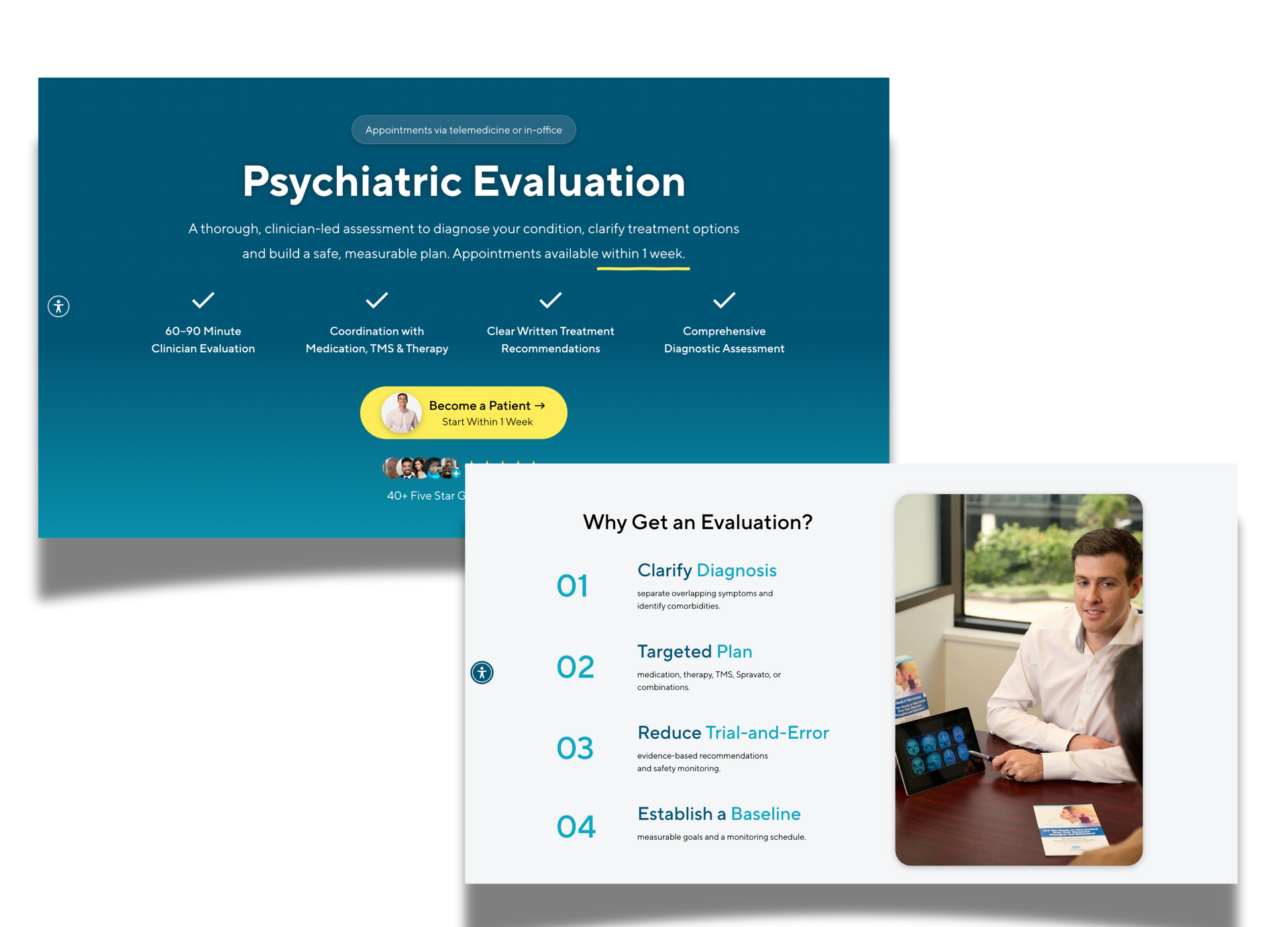
Website Design for Healthcare Providers: What Actually Matters

Leo Cook
22 May 2024
Want Your Website to Perform Better?
If you’re looking to improve conversions, strengthen your SEO, or build a site that actually supports your growth.
Quick Overview
Healthcare websites are often judged by their appearance. Clean layouts, soft colour palettes, and modern typography tend to dominate design discussions.
But in healthcare - particularly in mental health and specialist treatment clinics - aesthetics alone do not drive growth.
What matters far more is clarity, trust, structure, and guided action.
A healthcare website is not a design showcase. It is a decision-support tool for patients who are often anxious, uncertain, and actively comparing providers.
Clarity Within Seconds
When someone lands on a healthcare website, they are usually asking a few immediate questions: Can this provider help me? Do they treat my condition? What do I do next?
If the homepage does not answer those questions quickly and clearly, users disengage. Strong healthcare websites lead with who the clinic serves, what treatments are offered, where it is located, and a clear next step. Ambiguity increases drop-off. Clarity builds confidence.
Trust Is the Foundation
Healthcare decisions require reassurance. Patients look for credibility signals before they take action.
Effective website design integrates provider credentials, professional photography, testimonials, insurance information, and clear contact details naturally throughout the site. These trust elements should not feel buried or secondary. Design should reinforce credibility, not distract from it.
Structured Conversion Flow
Many healthcare websites function as digital brochures. They provide information but fail to guide action.
A high-performing healthcare site includes a strong primary call to action and reinforces it consistently. Whether that action is scheduling a consultation, verifying insurance, or completing an eligibility form, the next step must be obvious. Users should never have to search for what to do next.
Transparency Reduces Friction
Uncertainty is one of the biggest barriers in healthcare marketing. Patients often want to understand insurance acceptance, pricing expectations, appointment availability, and treatment timelines before reaching out.
When this information is addressed clearly, hesitation decreases. Transparency builds trust, and trust increases enquiries.
Mobile Experience Matters
A significant portion of healthcare searches happens on mobile devices. If a site loads slowly, buries contact information, or makes calls-to-action difficult to tap, engagement drops quickly.
Mobile-first design prioritizes speed, readability, and simplicity. The most important information should be accessible without friction.
Design and SEO Must Work Together
Website design and search visibility should not be separate conversations. A modern website that is not structured for search engines limits growth potential.
Proper heading structure, organized service hierarchies, internal linking, and well-structured FAQs support long-term visibility. Design should enhance discoverability, not compete with it.