SEO for Mental Health Clinics: A Practical Framework

Leo Cook
22 May 2024
Want Your Website to Perform Better?
If you’re looking to improve conversions, strengthen your SEO, or build a site that actually supports your growth.
Quick Overview
Search behaviour in mental health has changed.
Patients no longer rely solely on referrals. They actively search for treatments, providers, insurance coverage, and comparisons between options. Queries such as “TMS therapy near me,” “psychiatrist accepting insurance,” or “Spravato clinic [city]” represent high-intent opportunities.
For mental health clinics, visibility in search results is now foundational to growth.
However, SEO in this space is not the same as SEO for general businesses. It requires trust, clarity, and a structure built around patient intent. Below is a practical framework for building sustainable organic growth.
Start With High-Intent Service Pages
Many clinics begin their SEO efforts by publishing general mental health blog posts. While educational content has value, informational traffic alone rarely drives meaningful enquiries.
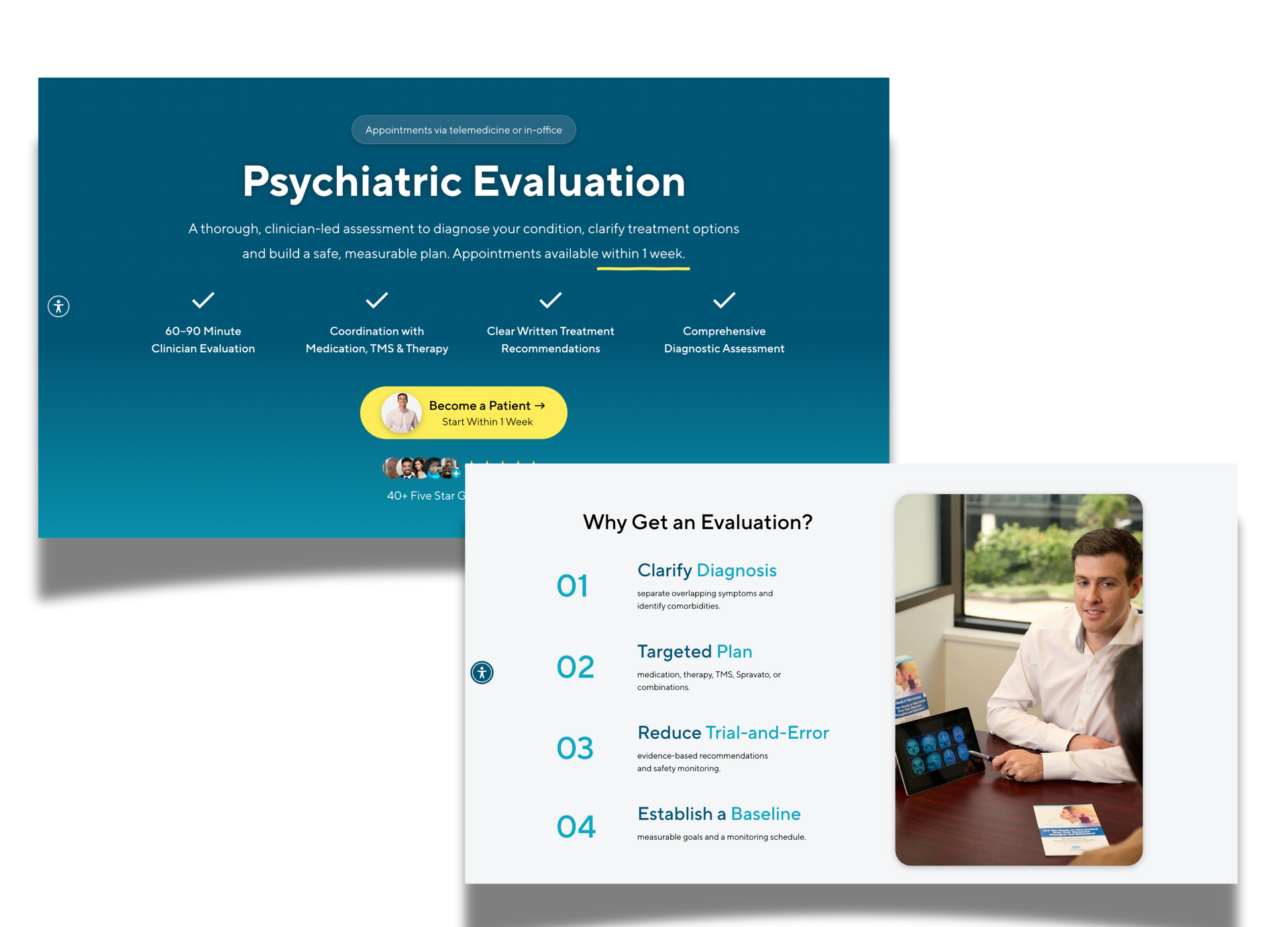
The foundation of SEO for a clinic should be its service pages.
Core treatment pages - such as TMS, Spravato, medication management, or therapy - should be fully structured and optimized first. In addition, condition-specific pages (depression, anxiety, OCD, PTSD, ADHD) should be clearly developed and aligned with how patients actually search.
Each service page should answer key questions clearly: who the treatment is for, what outcomes patients can expect, what insurance coverage looks like, and what the next step involves.
Service intent drives enquiries. Blog content strengthens authority.
Establish Local Authority Before Scaling
Most clinics operate within a defined geographic area. Local visibility is critical.
Before expanding into broad content strategies, foundational local SEO should be properly implemented. This includes optimizing the Google Business Profile, ensuring consistent name, address, and phone information across directories, and embedding location signals naturally into service pages.
Ranking nationally is far less important than being visible in your own city. The local authority should be established first, then expanded outward.
Align Content With Real Patient Questions
Mental health SEO performs best when it addresses genuine patient concerns.
Patients frequently search for practical, decision-based information such as whether TMS is covered by insurance, how long Spravato lasts, whether they can drive after treatment, or how TMS compares to medication.
Developing content that answers these questions builds topical authority and increases trust. It also improves conversion readiness because patients feel informed before they reach out.
This approach - often referred to as “They Ask, You Answer” - is particularly effective in healthcare marketing, where reassurance and clarity matter deeply.
Optimize for Conversion, Not Just Rankings
SEO traffic without conversion does not support growth.
Every optimized page should be structured to guide a decision. This means clear headings aligned with search intent, logical content flow, transparent insurance information where appropriate, and defined calls to action placed strategically throughout the page.
Search engines reward relevance and clarity. Patients respond to trust and direction. Both must be considered simultaneously.
Build Topical Depth Over Time
Sustainable SEO requires consistency and depth.
Rather than publishing isolated blog posts, clinics should develop content clusters around core treatments. For example, a TMS-focused content structure might include pages covering accelerated TMS, comparisons with medication, insurance coverage, safety, and patient expectations.
When these pages are interlinked and built around a central treatment theme, search engines recognize the depth of expertise. Over time, this strengthens rankings for competitive service keywords.
Monitor and Refine
SEO is not a one-time project.
Monitoring keyword performance, user behaviour, and conversion paths allows clinics to identify gaps and opportunities. Pages can be updated based on new patient questions, expanded into related treatments, or restructured if they are underperforming.
Growth compounds when the framework is maintained consistently.
Want Your Website to Perform Better?
If you’re looking to improve conversions, strengthen your SEO, or build a site that actually supports your growth.